
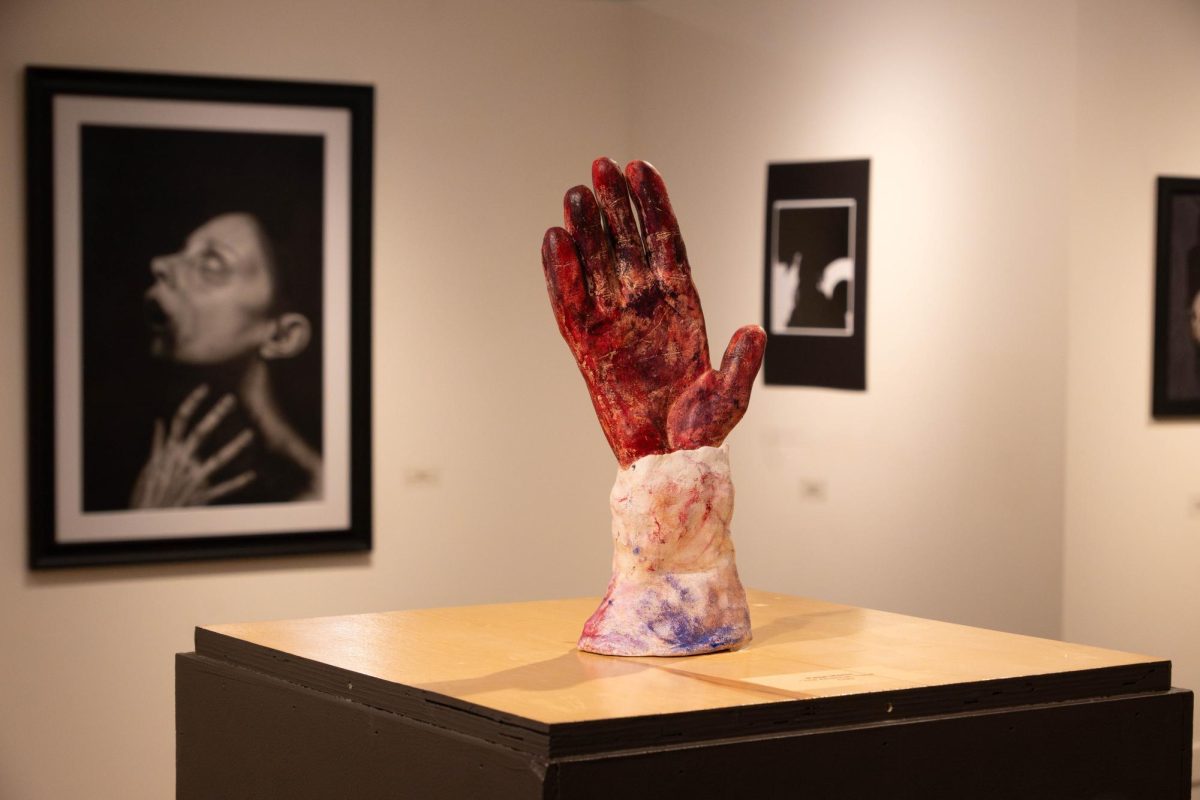











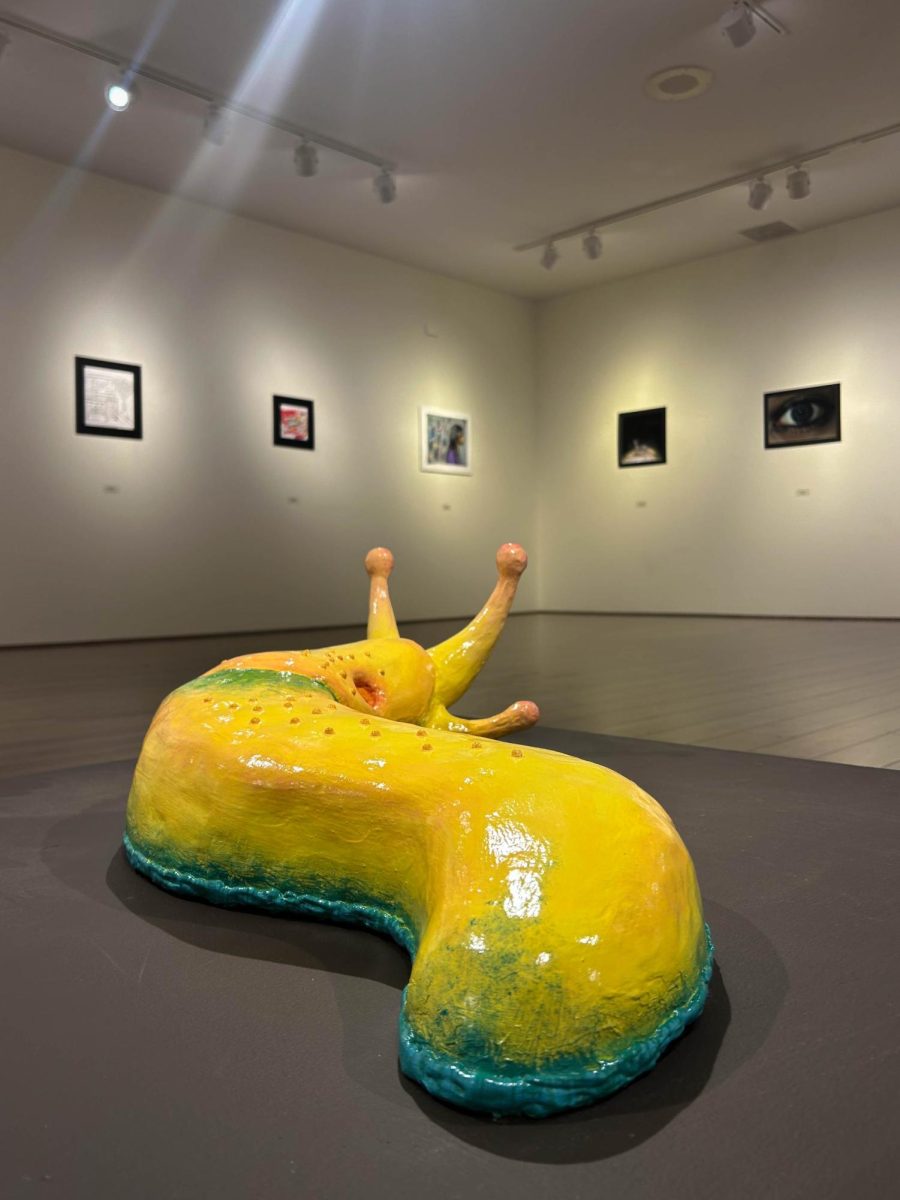
This fall, local high school students were chosen to display their work in JJC’s Laura A. Sprague Art Gallery. The exhibition, opened Nov. 3, will run through Dec. 5, with awards taking place on the final day. This annual showcase highlights the talent of local high school students, as well as the dedication of their art faculty. Each school was invited to select up to five pieces of student work to represent their program, with submissions spanning from drawing, painting, design, 3D sculpture, ceramics, and photography.
According to Gallery Director Suzanne Gorgas, each exhibition begins either with “a show proposal submitted by an artist or, as in this case, a call for entries.” Once the submissions arrive, gallery staff begin the installation process.
“We unpack the pieces and lay out the gallery for the best possible composition to bring unity throughout the exhibition,” Gorgas explained. From there, each piece is carefully spaced, measured, and installed. Title cards and wall information are prepared for each work, and lighting is adjusted to best highlight the content. The final touches include printing supplementary documents, such as artist statements or exhibition booklets, and scheduling events such as artist talks or receptions.
“After an exhibition, most of that process is repeated in reverse as we prepare for the next exhibition,” Gorgas added.
This year’s exhibition features 62 individual pieces from 13 local high schools, providing participating students with valuable experience regarding gallery exhibitions, studio facilities, and interacting with JJC’s visual arts faculty and current students. Several JJC students served as “student ambassadors” during awards night, giving tours and answering questions for high school students and their families.
Beyond simply viewing, students can gain hands-on experience through gallery workshops or by serving as a student gallery assistant. Each year, one student is hired to help with installations, events, and gallery operations, providing a unique learning opportunity in arts administration.
JJC Visual Arts faculty will select first, second, and third place awards from the submissions. These awards will be presented on Thursday, Dec. 5, from 5:00-7:00 p.m.
The Laura A. Sprague Art Gallery, located in the J-Building on JJC’s Main Campus, is open Monday through Friday from 8:00 a.m. to 8:00 p.m. Students, faculty, and community members are welcome to explore the exhibition at any time during those hours.
When asked about the impact she hopes this exhibit has on students, Gorgas said, “I hope each exhibition encourages our students and the community to look at and/or create visual artwork, [and] encourages the high school students to do the same, helping to highlight what we have to offer as a place of continuing contemporary art education.”
And this is not the first time an event like this has taken place. According to Gorgas, JJC’s art exhibition has a long-standing tradition. “JJC has housed and operated an art gallery since 1975, and the first gallery director was Dee Nemeth,” she explained. Richard Ainsworth served as the second director, followed by Joe Milosevich, who established the permanent student art collection in 1984.
“The space that we know as the Laura A. Sprague Art Gallery opened in 2012. I became the fourth gallery director in the fall of 2017,” Gorgas added.
The director hopes visitors understand the welcoming environment and purpose of the gallery. She provided a quote from the first gallery director, Dee Nemeth, from 1975, hoping to do that very thing:
“The personality of a gallery is multi-dimensional. It can choose precious works, be reserved, or require participation on the part of the viewer. It can have things in it which invite the viewer to experience it in some way or another. A Gallery can be casual or historical. It can be cross-cultural. It should address itself to the needs of the community with an eye to adding to the community awareness of itself and what’s happening elsewhere.”
“That is to say,” Gorgas explained, “this space welcomes anyone and everyone to spend time with the space itself, with the work, and often with the artists, because visual art is, after all, both communication and reflection… and for everyone.”