














Most people get their first tattoos as soon as they are legally able, often persuading their parents to sign the release form once they turn 16. Many later admit they regret it—or would change something about that first permanent mark on their skin.
But what happens when your first mark comes at eleven years old?
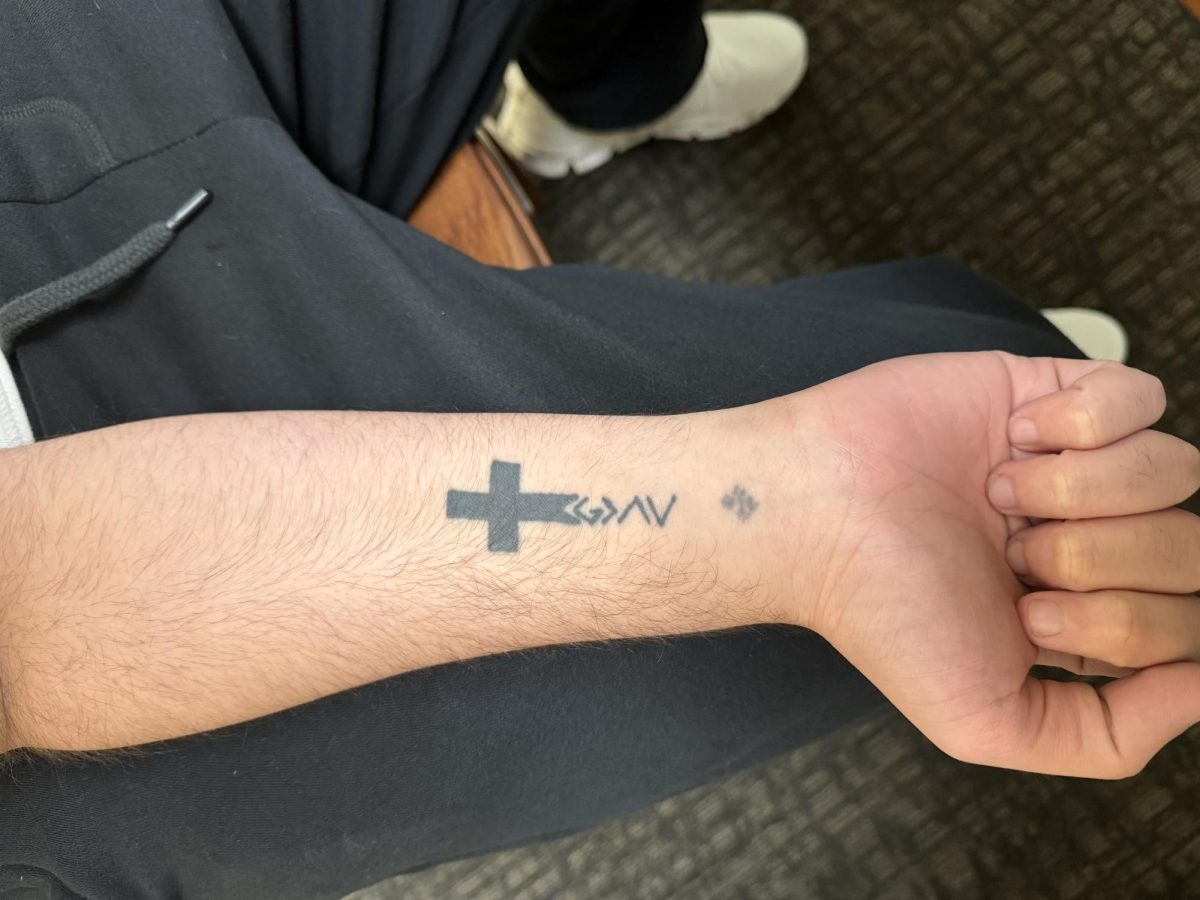
Joliet Junior College student Kerolos Hana, who is finishing up at JJC before transferring to DePaul this fall, doesn’t have just one tattoo. He has two. Both sit on his right wrist. Both are rooted in religion, memory, and identity—but only one tends to be noticed first.
“I think when I tell people I have a tattoo, they assume it’s just this cross right here,” he said, pointing to the bolder piece running along his arm—a cross with geometric extensions spelling: “God is greater than the highs and lows.”
“This tiny one though… this one is the special one,” Hana said.
The “tiny one” is a Coptic cross—four points connected by thin intersecting lines, small enough to disappear at a glance but impossible to separate from its meaning once understood. Over time, the ink has faded slightly, and a faint green tint still lingers beneath the skin, a remnant of its healing process.
That color comes from molokhia, an Egyptian spinach used in traditional healing. Rich in chlorophyll and plant compounds, it was pressed into the fresh tattoo hours after it was made—meant to soothe the skin, but now functioning as something else entirely: a reminder of where it came from.
Where most people search for the nearest tattoo studio, Hana crossed borders and international waters to receive his.
“It’s not like it was legal here,” he said, laughing at the absurdity of it now.
In 2016, at the Monastery of the Holy Virgin Mary in Assiut, Egypt, during a Christmas festival, Hana says he was “marked.”
And unlike most tattoos, that word doesn’t feel metaphorical in his case.
At first, the meaning wasn’t clear to him.
“At first, this tattoo didn’t really mean much to me,” he said. “That was because I didn’t understand its history or significance.”
That understanding came later, after returning home to Plainfield, through questions that slowly accumulated—questions from classmates about why he was the only one in school with a tattoo, concerns from teachers, and his own curiosity about why his family treated it as something ordinary.
“I remember that day almost as if it were yesterday,” Hana said. “My grandfather held my hand throughout the entire 15-minute process and got me this toy airplane with a screen preloaded with games like Snake and Tetris.”
His entire family gathered for the occasion—five of his mother’s brothers with their wives and children, three aunts, and a circle of cousins surrounding him in celebration.
“We all have one,” Hana said. “Even my younger siblings. They were a bit older when they got theirs, but my parents thought it was important at the time—and I agree with them now as well.”
The tattoo is not simply a cross—it is a Coptic cross.
Historically, Coptic Christian communities in Egypt have endured periods of religious pressure and shifting rule. Over centuries, their identity has often been tied closely to visible symbols of faith, passed down through generations as both expression and preservation of heritage.
In 2006, Hana and his family immigrated to the United States, carrying that history with them.
What was once a private marker within a community became, for Hana, something more visible in a place far from home, now paired with a second tattoo that makes his first symbol more noticeable, and often prompts questions, misunderstanding, and curiosity.
“This tattoo brings me a huge sense of pride in my culture and my religion,” Hana said. “I love being asked about it so I can introduce people to a story they may not know. That is the meaning I tell people as well.”
But for Hana, it is not just a story he tells. It is something he carries on his skin every day—something that began as a mark placed on him, and became, over time, something he has learned to fully understand and claim as his own.

A. Aguilar • May 7, 2026 at 3:58 pm
I enjoyed reading this very much. I appreciate Kerolos Hana sharing his story and faith. I wish him all the best as he continues his education at DePaul. Blessings and peace to him.