



You see veterinary clinics in almost every community, but many people do not realize the amount of training required to care for animals in a medical setting.
At Joliet Junior College, the Veterinary Technology program prepares students for careers as veterinary technicians through a combination of classroom learning, hands-on labs and daily animal care responsibilities.
Abby Panozzo, associate professor and program director of the Veterinary Technology program, oversees the curriculum and faculty while also teaching several courses.
“My primary role is program director, so I oversee things like the curriculum and the faculty,” Panozzo said. “We are an accredited program, so there are certain standards that we have to meet to maintain that accreditation.”
Panozzo has worked at JJC for six years and became program director two years ago. In addition to administrative responsibilities, she teaches multiple courses including small animal nursing, anatomy and physiology, surgery and animal care.
Students in the program work closely with animals throughout their training. Each semester, about 24 animals live on campus as part of the program.
“For students, the day-to-day life is that they’re all assigned kennel duty,” Panozzo said. “It’s their responsibility to come in and exercise the animals, feed them, give medications and care for all the animals in the program.”
Morning students typically arrive a few hours before class to complete kennel shifts, while evening students complete those responsibilities after class.
Students usually attend two classes each day that combine lectures with hands-on lab work. Panozzo said the program is structured to resemble the real life environment of a veterinary clinic.
During a recent visit to the program, I attended a vet tech lab to observe what an everyday class looks like for students.
When I arrived, first year students were gathered in the lab practicing blood draws on animals under instructor supervision. I watched students work in small groups and carefully restrain dogs and while locating veins another student collected samples.
Classmates nearby took notes and made sure the animals were calm. Peanut butter and treats were on stand by for animals that were agitated.
“The first few weeks they come in, they’re learning about restraint and handling, body language and medications we use for animals,” Panozzo said.
As students progress through the program, those responsibilities get more advanced.
“The first year is very introductory to veterinary medicine. We start them off with a really good foundation, and then as they move through the program, we increase the difficulty,” Panozzo said.
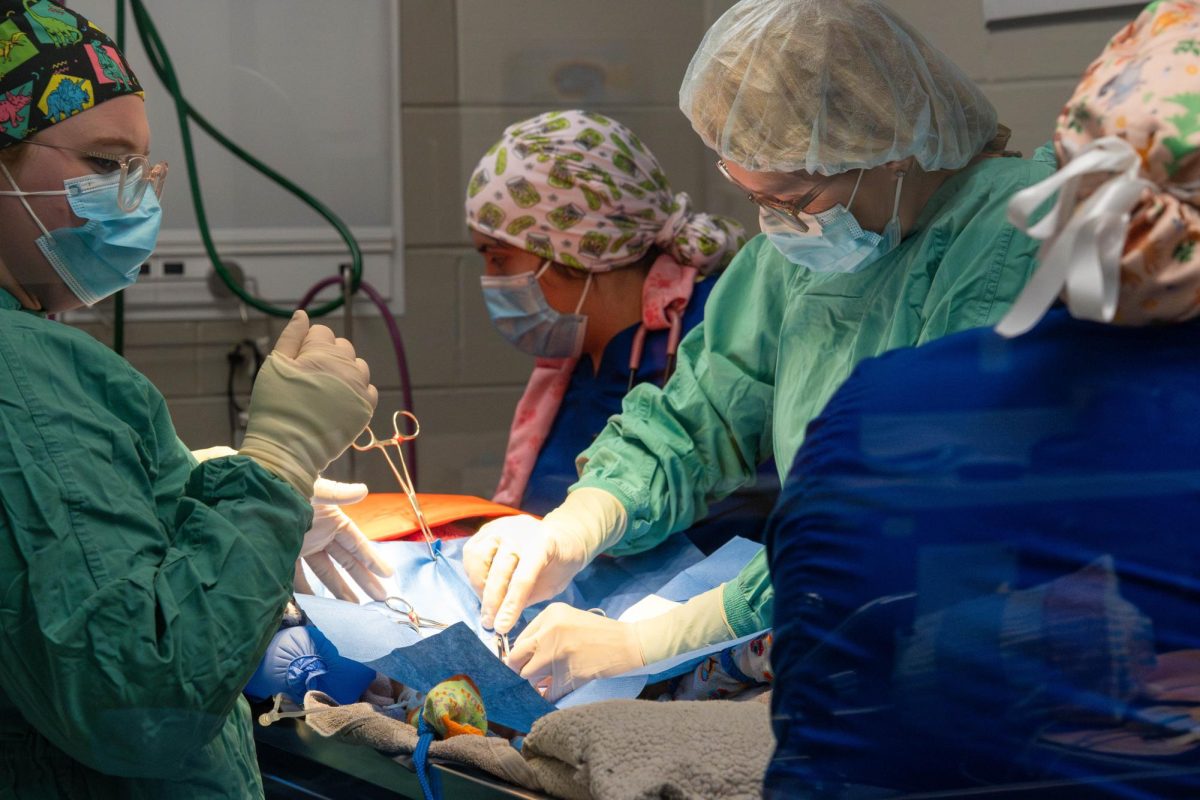
At another visit, I watched second-year students assist during a live surgical procedure. A neuter of a dog that is soon to be adopted.
Students were preparing instruments, monitoring anesthesia and tracking the patient’s vital signs throughout the operation.
“They’re right next to her during the entire surgery process,” Panozzo said. “So it’s very immersive.”
Many of the surgeries performed in the program involve animals that are eventually placed up for adoption. Panozzo said the program works to ensure most of the animals’ medical needs are addressed while still at the school. This gives students experience while preparing the animals for adoption.
Procedures such as spaying or neutering, vaccinations and other medical treatments the animals may need are performed by the veterinarian with assistance from students.
“Those procedures could cost families thousands of dollars at other clinics,” Panozzo said.
The animals in the program come from a variety of situations. Dogs are brought in from local shelters, where they may have come from more difficult situations.
The program also occasionally receives beagles that previously lived in research facilities where animals were used for testing.
Panozzo said the program is designed to mirror the responsibilities students will face in veterinary clinics after graduation.
“I would describe it almost like a job,” Panozzo said. “Even in the veterinary field, kennel shifts mimic what a veterinary assistant would do. Students are learning the medical side of it while also experiencing what that work environment feels like.”
The program also exposes students to a variety of animals beyond household pets. In large animal nursing classes, students work with horses, cattle, pigs and goats on local farms. Another course focuses on exotic and wildlife medicine.
Kyle Kasik, a first year student in the program, said the amount of information initially surprised him.
“It was shocking at first how much information you have to take in,” Kasik said. “But learning more in depth how everything is connected and relevant to our job has made it more digestible.”
Balancing the program with outside responsibilities can also be difficult.
“The biggest challenge I’ve faced so far has definitely been time management,” Kasik said. “With working full time and school full time, it is so important to stay on top of everything, especially with how fast paced the program is.”
Despite the demanding schedule, Kasik said the instructors help make the experience rewarding.
“My favorite thing about the program is definitely the staff,” Kasik said. “Everyone from the instructors to the technicians are so well versed in what they do and really do a great job of teaching and connecting with students.”
Panozzo said understanding animal behavior and stress is also an important part of veterinary care.
“Mental health in humans and animals is directly related to physical health,” Panozzo said. “If an animal is really stressed, we have to address that before we can fully help them physically.”
The program accepts up to 48 students each fall semester 24 in daytime classes and 24 in evening classes. Students must complete prerequisite courses before applying.
Logan Torres, who hopes to enter the program, is currently completing prerequisite classes while working at a local clinic.
“Being around that setting is really helping me get prepared for things I’m sure to see in the program,” Torres said.
Panozzo said the career requires more than just a love for animals.
“A lot of students say they love animals and want to be a vet tech,” Panozzo said. “But you also have to love medicine, math and science. If you love all those things together, then veterinary technology is a perfect career.”