









Joliet Junior College students spent Friday, Feb. 20, practicing how to discuss controversial and political issues with their peers during a summit aimed at strengthening civil dialogue on campus. A skill student leaders and college organizers hope to support and develop.
The summit was organized by student government leaders Bryon McCullum, Stephen Richardson, Jazlyn Sision, Mason Patterson, Kristen and Isiaha, along with Vice President Angel Cercy and Director of Student Activities Dr. Amy Kuspa Sims. The event was held from 11 a.m. to 4 p.m. in the U-building Auditorium.
The event was divided into two halves. The first featured workshops and activities led by student government members and Braver Angels, an organization focused on strengthening democracy through debate. The second half included a civil discourse conversation about power and how to wield it, presented by the Urban Center.
Walking into the auditorium, students were given name tags and encouraged to get to know each other while waiting for the presentations to begin. About 37 students attended, and shortly after introductions from student government and Vice President Cercy, the first activity began.
Finding bias can be difficult, especially when talking with someone you have just met. Students may not yet know enough about another person’s background to understand why they think the way they do.
Small baskets of assorted candy were passed down the rows of students. Each participant was instructed by Cercy to take a handful of candy and pass the basket to the next person.
“Skittles vs. Giggles” was the name of the activity and referred to the two candies students could choose from. The front row was fairly split between the two options, while the row behind them held almost exclusively the better-known brand.
Students were then asked to reflect on the brand they chose and consider why they made that decision. Was it a familiar brand they loved? Was it based solely on taste? Did facts play any role in the choice? Participants were reminded that decisions are often influenced by different factors — and recognizing those influences is the first step in understanding bias.
The activity served as an introduction to the presentations led by Braver Angels, where students’ personal biases would be examined.
Braver Angels is one of the largest organizations in the nation focused on civil discourse. Its goal is to strengthen democracy through debate, emphasizing that in order to debate effectively, people must be able to discuss the issues that affect them.
“Are you choosing connection or domination?” said Maryanne Colter, Illinois state coordinator for Braver Angels.
Debate is not about winning or losing — it is about understanding. To do so, participants must build stronger listening skills, actively acknowledge others’ experiences and avoid resentment toward opposing viewpoints. As students moved through slides and discussions about improving these skills, they were reminded that connection should be the goal. Understanding, organizers said, should remain at the forefront of difficult conversations.
“Democracy fails when you believe your neighbor is evil,” a video presentation stated.
Following the presentation, students participated in an activity focused on discussion and debate.
The prompt asked whether “the internet creates a healthy environment for students online.” Students were instructed to think about their position and move to opposite sides of the room. The left side represented disagreement, while the right side represented agreement.
The goal of the exercise was not to win the debate or convince others to change their views, but to better understand why people hold different perspectives. Students took turns explaining why they chose their side of the room.
“As someone who was homeschooled for most of my life, being online gave me opportunities to meet friends and create a community,” said Alex, a participant in the discussion.
Organizers emphasized that the purpose of the exercise was not to change someone’s mind, but to understand the experiences that shape their beliefs. Participants were encouraged to ask deeper questions: Why do people believe what they do? How do personal experiences influence opinions? What values and emotions shape those views?
According to presenters, asking those questions is key to having productive conversations and building stronger civic dialogue.
When the floor opened for questions, the discussion turned to the challenges of engaging with harmful ideas.
“How do we deal when the ideas of someone else are actively leading to harm?” asked Caleb, a student in attendance. “And at what point do we call them out on it?”
Presenters acknowledged the difficulty of the question and explained that conversations around deeply held beliefs can be challenging. Demonstrators encouraged students to approach these discussions calmly, focusing on understanding the person rather than immediately confronting them. By approaching conversations thoughtfully, they said, participants may be able to reduce tension and keep dialogue productive.
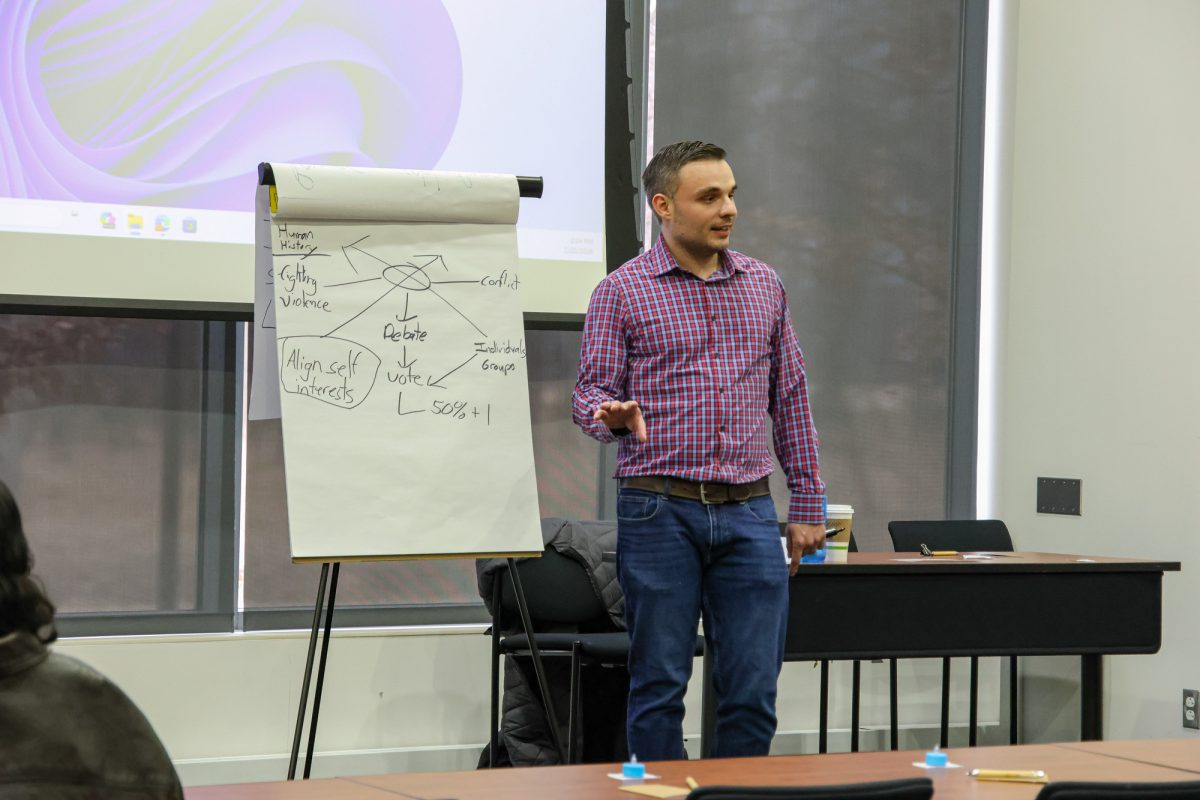
After the Braver Angels workshops concluded, the summit transitioned into its second portion of the day. Bobby Sylvester, a representative from the Urban Center, led a discussion focused on power — who holds it, how it functions within government and communities, and how students can become more active participants in civic life.
The presentation took on a more free-form discussion style, with students casually conversing with Sylvester and asking questions about government and civic engagement.
The conversation began with a simple question: What does the word “power” mean? Many students associated it with negative ideas such as violence, corruption or absolute authority.
Sylvester challenged that perception. Power, he explained, is simply the ability to act.
“The power that you give power is what you use it for,” Sylvester told the group.
According to the Urban Center, collecting and organizing power allows communities to push for meaningful change. By understanding how power works — and how it moves through institutions such as local and state government — individuals can better advocate for the issues that matter to them.
Sylvester also discussed the role of self-interest in politics. Politicians, he said, often respond to what voters want because their success depends on public support.
As an example, Sylvester referenced former President Barack Obama’s evolving stance on same-sex marriage during his presidency. He used the example to illustrate how political positions can shift as public opinion changes.
According to Sylvester, understanding that relationship between voters and elected officials can help communities use their collective influence more effectively.
By the end of the afternoon, the summit shifted into a quieter period of reflection. After a day spent examining bias, debating ideas and discussing the role of power in civic life, students were encouraged to think about what they had learned and how those lessons might shape their future conversations.
Throughout the summit, organizers repeatedly emphasized that the goal was not to win arguments or prove others wrong. Instead, the focus remained on learning how to listen, ask better questions and understand the experiences that shape other people’s beliefs. While disagreements were expected, the hope was that those disagreements could lead to deeper conversations rather than division.
By the end of the event, the summit had moved from examining personal perspectives to exploring the broader systems that shape society. Organizers said they hope the conversations that began that day will continue beyond the auditorium, encouraging students to approach difficult discussions with curiosity, empathy and a stronger sense of civic responsibility.
When asked whether the summit could become an ongoing event, Sims said it could potentially merge with or complement the Board of Trustees panel that the college holds twice a year.
Students also demonstrated a willingness to engage with complex issues and participate in discussions about civic life, organizers said.
“JJC is different — we do things first. We do things best,” Cercy said.